

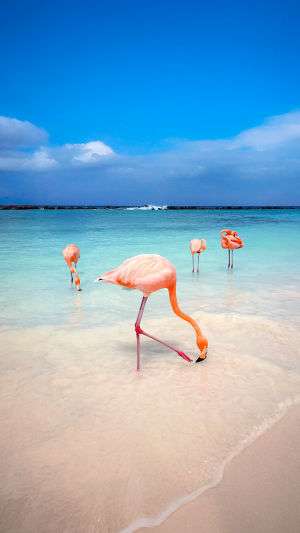
On a quiet morning by a sparkling lake, we might catch sight of flamingos standing gracefully on one leg, their long necks forming elegant S-shapes.
These striking birds belong to the Phoenicopteridae family and are much more than just a colorful scene.
They grow to about 1 to 1.4 meters in height, with wingspans reaching 1 to 1.6 meters. Their famous pink feathers aren't natural—they get their color from pigments in the algae and tiny crustaceans they eat.
Watching them is like seeing a living painting unfold, with each bird perfectly adapted to wade through shallow waters, almost like acrobats on stilts.
<h3>Where Flamingos Live</h3>
Flamingos are highly adapted to wetlands. We find them in salty lakes, lagoons, and marshes across Africa, Central and South America, and Southern Europe. They occasionally appear in cooler regions, but their main habitats are warm, food-rich wetlands. Some species, like the Chilean flamingo, avoid lakes with fish because fish eat the tiny creatures flamingos feed on.
By observing this, we understand how ecosystems carefully balance every species. Wetlands not only provide food but also safety for breeding and raising chicks. We can even notice small differences between habitats: in some areas, flamingos gather in huge flocks, while in others, smaller groups dominate.
<h3>Eating and Feeding Habits</h3>
Flamingos feed mainly on algae, plankton, and tiny invertebrates. They have a specially shaped beak where the upper part is smaller than the lower, allowing them to filter food from water efficiently. We can watch them sweep their heads side to side while feeding, creating ripples in the water. Their diet directly affects their color: more pigment-rich food results in brighter pink feathers.
Watching a flock feed is mesmerizing—they seem to move together like a synchronized ballet, each bird gently stirring the water with its feet. Feeding is not just about survival; it's a performance shaped by nature.
<h3>Flamingo Families</h3>
Flamingos are devoted parents. Each female lays a single egg in a small mound-shaped nest, measuring around 78–90 millimeters and weighing 115–140 grams. Both parents take turns incubating the egg for 27 to 31 days. Flamingos reach maturity between three and five years old, meaning they invest a lot of time before starting a family.
Observing a nesting colony is fascinating: we can see parents feeding and guarding their chicks, and the young ones learning to wade through shallow waters. This family dedication shows us the importance of patience, cooperation, and care in raising the next generation.
<h3>A Stunning Sight in Nature</h3>
Imagine a shallow lake in the Serengeti, filled with flamingos. Their synchronized movements create a rhythm, as if the entire flock is dancing together. We see heads bent, necks curved, and feet stirring the water in harmony. The lake turns into a living artwork painted in soft pink. It's not just beautiful; it's a reminder that nature thrives on cooperation, patience, and harmony.
The more we watch, the more we notice subtle interactions: some birds nudge each other gently, others compete for the best feeding spots, and yet the flock moves as one.
<h3>Why We Admire Flamingos</h3>
Flamingos fascinate us because of their color, social behavior, and unique biology. Observing them teaches us how diet influences appearance, how habitats shape behavior, and how species interact within ecosystems. We also learn about adaptability—some flamingos travel long distances to find suitable habitats or migrate when lakes dry up.
Every glance at a flock reminds us to slow down, notice life's subtle wonders, and appreciate the balance of nature. Their elegance inspires creativity, patience, and a sense of calm whenever we encounter them.
<h3>Fun Facts About Flamingos</h3>
Did you know flamingos often stand on one leg to conserve body heat and balance, and that their knees bend backward, which is actually their ankle joint? We can also notice their social habits: flamingos form large colonies to increase protection against predators and to make feeding more efficient.
Watching them interact is like seeing a community that communicates silently through movement, posture, and subtle sounds. It's a perfect example of how living creatures support and influence each other in nature.
<h3>Nature's Pink Masterpieces</h3>
Lykkers, flamingos are more than beautiful birds—they are symbols of balance, resilience, and natural artistry. Whether we spot them in a tropical lagoon or a subtropical lake, every moment with them highlights the delicate harmony of life.
Next time we see a splash of pink on the water, let's pause and enjoy the story these remarkable birds are telling us. Their beauty reminds us to respect ecosystems, appreciate patience, and embrace the small wonders around us every day.
Pink Flamingo 4K Video Ultra HD | Most Beautiful Birds in the World
Video by Look at the world 4K


